What does it mean to win a game? What do you get?
Is it a celebratory screen, with an explosion and fireworks? Is it a close up of your character flexing, the dejected enemy in the background contemplating how they got to this point in their lives, being a rhetorical device in a never-to-be-read-by-anyone blog post?
Or is it experience points? Ranked points? Matchmaking rating? Progress on your battlepass? Perhaps a challenge checked off, an entry in your list of recent games with a W in the outcome column? Is it a percentile adjustment on your overall win/loss ratio, which no matter what you do will trend towards 50% so long as the matchmaking algorithm works?
Or is it the memories you made along the way? A particular play of yours that stands out in your recollection? Perhaps even the game (or the game’s heuristic algorithms) recognized you with play of the game, forcing everyone to sit through a replay of you pressing your ultimate and getting four cheap kills? (Forgive my Overwatch slander; I’ve been the presser of that ultimate button more than once, and I’m ashamed to say I enjoyed the cheap ass play of the game shoutout). Maybe that’s the meaning of a win, to know that you were, or were made to be seen, by others. That the game grabbed your former enemies’ and allies’ collective backs of the heads and pushed their eyeballs into the screen, saying, or implying, “here! Look what John Q. Gamer hath wrought! Is he not glorious? Is he not splendiferous? Does his life not have meaning, here and now in this fleeting play of the game?”
Or is the meaning of winning a game that you’re 27 minutes closer to death, having whiled away another chunk of your god given time, having refused to be productive under capitalism (unless, of course, you were streaming your game or otherwise transmuting your enjoyment or dejection into CONTENT, the most ironically named category) (pay attention, Alanis Nadine Morissette!)
Or is the meaning of a win that you extracted with a full backpack, virtual value stored in your vault, a series of ones and zeroes moved from one database to another, meaning that you can finally craft a second Torrente?
It means all that, and sometimes all that means nothing, at which point that win has lost.
Today I want to talk about a two stage development in games, particularly FPS games, over the last 20 years or so. A change that has (probably) doomed arena shooters (unless we somehow go back to a full prize boxed model for online games) (everything I discuss in here assumes a need to have players play beyond the point of novelty and full mechanical exploration, which is a foregone conclusion for F2P games but also strongly applies to mid-price micro-transaction supported fare), that will probably be applied to other PvP genres (should a commercially viable PvP genre that isn’t a shooter ever arise again) (I am holding my breath, out of spite, turning blue in the face, but I admit it’s not likely in the near future) (yes, League of Legends and to a lesser degree DOTA2 still exist, geriatric day-care communities that they’ve become, but new entries to the MOBA genre aren’t exactly popping up like mushrooms, and even when they’re MOBA+shooter and backed by one of the richest companies in the space, they fall flat–Deadlock, this is about you), and that has me fundamentally changing the way I think about achievement and progress in the PvP space.
But first, let’s talk about DeathManager!
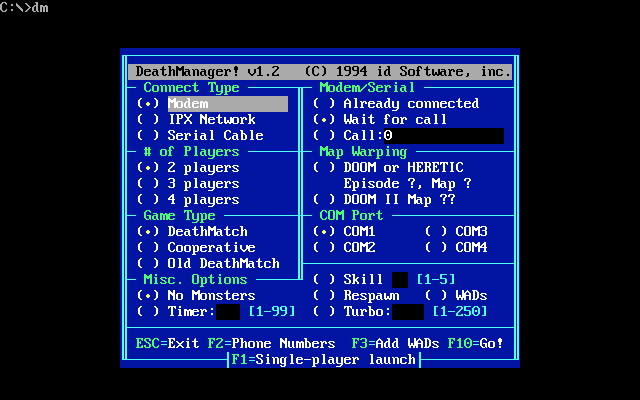
dm.exe was a quaint little frontend that made launching multiplayer DooM games easier (or at all possible? It was so long ago, none now live who remember it). Its UI was all ASCII, and the fact that setting up multiplayer games had to be done with this extremely janky looking little tool drove home just how much multiplayer wasn’t the point. There were no multiplayer specific maps (unless you count DooM II’s map 7, Dead Simple, which was pretty much all we ever played in LAN), no specific rulesets other than “spawn in and kill everyone and everything”, there were no leaderboards, no win conditions, and you just played until you were done playing (or until someone else arrived with their PC, needing to interrupt the BNC ring network, which would refuse to work again for the next hour or so).
My point is that initially, “run around in the same virtual space and kill each other” was its own reward. We didn’t even keep score. We certainly didn’t unlock exclusive Mountain Dew Code Red cosmetics. Although that would have been both very funny and very anachronistic.
Over time, as we discovered that, much like hell and soylent, content is other people, we started adding meaning to matches. Sure, you can win now; but you can also win by varying metrics. You can triple the rest of the lobby’s frags, or you can 1v3 in Warcraft 3 in 12 minutes with 40% more resource income than everyone else combined, or your team could win with 27 kills to 3. And so on.
We also added ranks. I’m not sure if the need for balanced games or the need to show off obnoxiously came first, or if they developed together in perfect harmony, but eventually once we started playing with strangers online, we really needed to optimize bragging. You can no longer say to your friend, “remember how I sat in the air vents and killed you 23 times last night?” and have everyone hoist you up on their shoulders celebratorily. Instead you need to be, I don’t know, Gold 2, or Emerald 1, or Rainbow 6.
Here we come to the first loss of meaning. As multiplayer gaming transitioned from “get your friends together in someone’s living room for a sweaty stinky weekend” to “log into this online service and play with randos”, we lost the meaning inherent in sharing an experience with friends. Sure, sometimes it’s a bad experience, but you’re still there with your friends, laughing at your misfortunes. Maybe you’re catching up in between firefights, maybe you’re just quietly and companionably spending some pleasant hours in each other’s presence, virtual or otherwise. The friction of finding friends who play and enjoy the same things you play and enjoy and of getting them to be online and wanting to play at the same time you are–it’s a lot of friction, and as we age and our friend groups shrink it becomes harder and harder to overcome this friction when instead we could just have the matchmaker throw us together with a handful of angry 13 year olds who are way too good at this game.
It’s an energy invested pleasure derived problem, and unfortunately I find that very often we default to lowest energy invested even if we know that our pleasure derived often will be negative.
But it’s okay! The games industry’s got you! Instead of making meaningful memories and deepening your relationships with real humans, you could unlock a Limited Edition Mountain Dew Code Red Zero Sugar skin and the new tea bag emote!
Less flippantly, extrinsic rewards for success (or participation) exist to increase your attachment to a game. Much could be said about intrinsic and extrinsic enjoyment and how the right type of extrinsic enjoyment can morph into its own intrinsically enjoyable loop (filling out challenges and crossing off todos, self-chosen and otherwise, can become an enjoyable game in and of itself), but at the core of it is meaning: what did it mean that you won this game? What did it mean that you played it? What did it mean that you spent time, that you performed pre-ordained actions from a checklist? If hitting 20 headshots with sniper rifles at 75+ meters isn’t its own reward, then hell, how about this unlock for doing it?
It feels like there’s something to do, that you’re making some kind of progress, that you’re doing a thing you’re supposed to be doing, and that is meaning.
Especially when you lock interactive content behind progression, you can drive a lot of player behavior and thinking with progression. If there’s 5 sniper rifles in the game but 3 of them can only be used after a player has hit a certain level in the recon class or done certain challenges, well then these goals accumulate meaning. No one cares about “I’m a level 30 recon class” in isolation; but you care that you now have another sniper rifle unlocked. You had been playing towards that goal, and even if it turns out the rifle sucks and you’ll go back to using the base rifle, for a fleeting moment there your actions had meaning.
But it’s a ratchet. By which I mean: you can’t ununlock a rifle. Once you’ve jumped through 16 hoops, honked 71 clown horns, and discussed 4 sublime moments of divinity, or whatever else is on challenge lists these days, you have the rifle in perpetuity.
So some genius came along and asked, but what if you didn’t?
What if unlocks were as ephemeral as the pursuit of meaning? What if the game says, congratulations, you have this incredible gun… for now. Well game, what have I got, a sniper rifle or a monarchy? –A sniper rifle, if you can keep it.
Extraction shooters substitute pain for meaning, and they’re the most meaningful we’ve discovered how to make rounds. You don’t unlock items on an arbitrary list. You make your own shopping lists, dive into the chaos of a vaguely East European dystopia (or in the case of Embark’s unprecedented innovation, a vaguely Italian dystopia), and hope to come out with more than you brought in. What you bring out has intrinsic meaning: you get to use it to craft things that you use in future runs. This isn’t just gameplay unlocks over cosmetic unlocks, this is temporary gameplay unlocks. I make this gun, and now I can use this gun, until an angry 13 year old snipes me and takes my gun. But loss brings forth renewal: you may have lost a valued gun, but you gained a shopping list of components to hunt for to make a new gun.
Over the last years we went from session based arena shooter type games, with their scoreboards and ranked systems (a zero sum situation if ever there was one), with repetitive and predictable gameplay even in the presence of the ultimate content remixer, other people, to the high game to game variance of battle royales, where there was meaning in what gameplay options could be gained inside ONE run (find an incredible gun? Damn this game just got interesting, and getting killed will suddenly hurt so much more), to finally the extraction shooter, where meaning persists beyond the individual session.
But so does loss.
What does it mean to lose a game?
Initially, nothing. Just a game. Maybe you didn’t even know you lost.
Then, as we built victory screens and stats pages and ranked systems, loss meant you adjusted your own self-worth downward. Maybe you got demoted. Maybe you’re too low level to play with your friends now. Eventually, of course, you trend back towards 50%.
Then loss meant the loss of an opportunity to enjoy gameplay you may not have experienced much before. Maybe you found a Kraber in a care package early in a game of Apex, and now equipped with the best, most unfair sniper rifle in the game… you run into a building and get gunned down by a bunch of people you didn’t even know where there. Congratulations to those people: they have a Kraber now. You? You lost. Specifically, you lost the opportunity to shoot the Kraber.
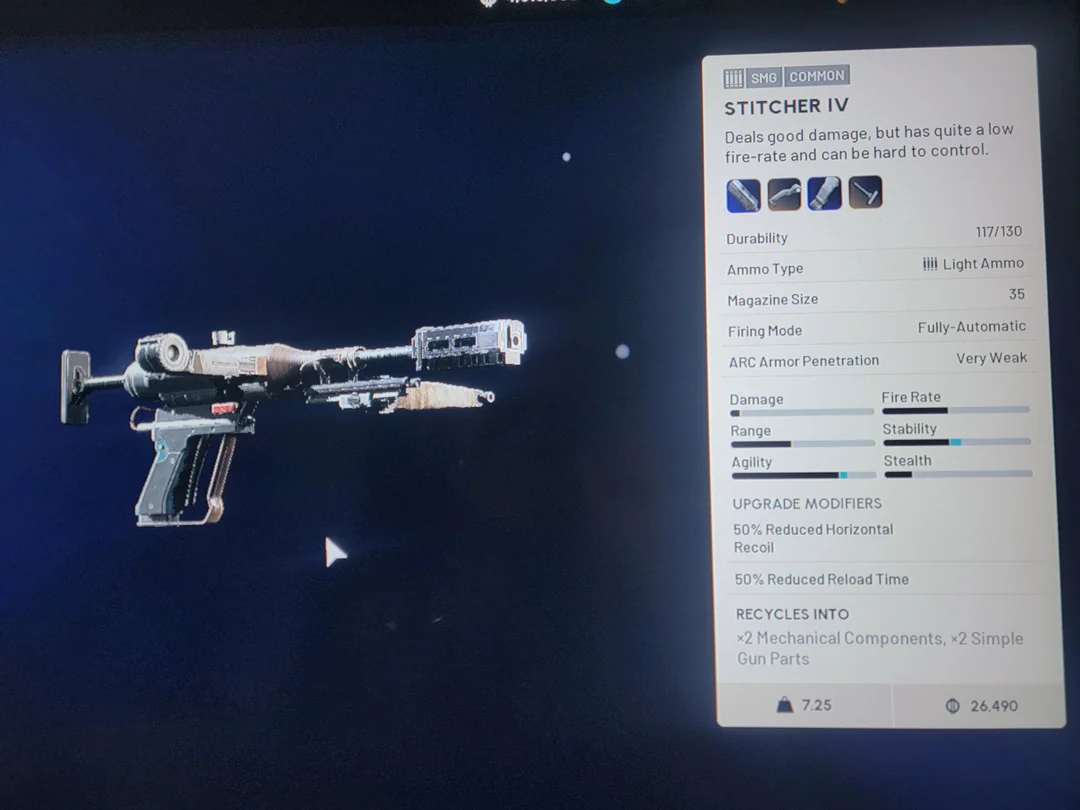
(peak endgame weapon)
But fast forward to Arc: Raiders, and pretend there were desirable end game guns in this game and that the best pvp gun wasn’t an early game Stitcher. Let’s pretend the Bettina was actually good. Well, losing one means that you lose the chance to use it this game and all future games, until you can craft / steal one again.
When wins mean more, so do losses. But that’s a good thing. Meaningful losses, losses that piss you off and get your blood boiling? We call those engagement. We call those anti-churn. Up to a point, of course. But knowing how much you stand to lose makes not just winning but also surviving more meaningful.